


Jeyms Webb telescope depicts a molecular cloud in the northern part of the Orion constellation
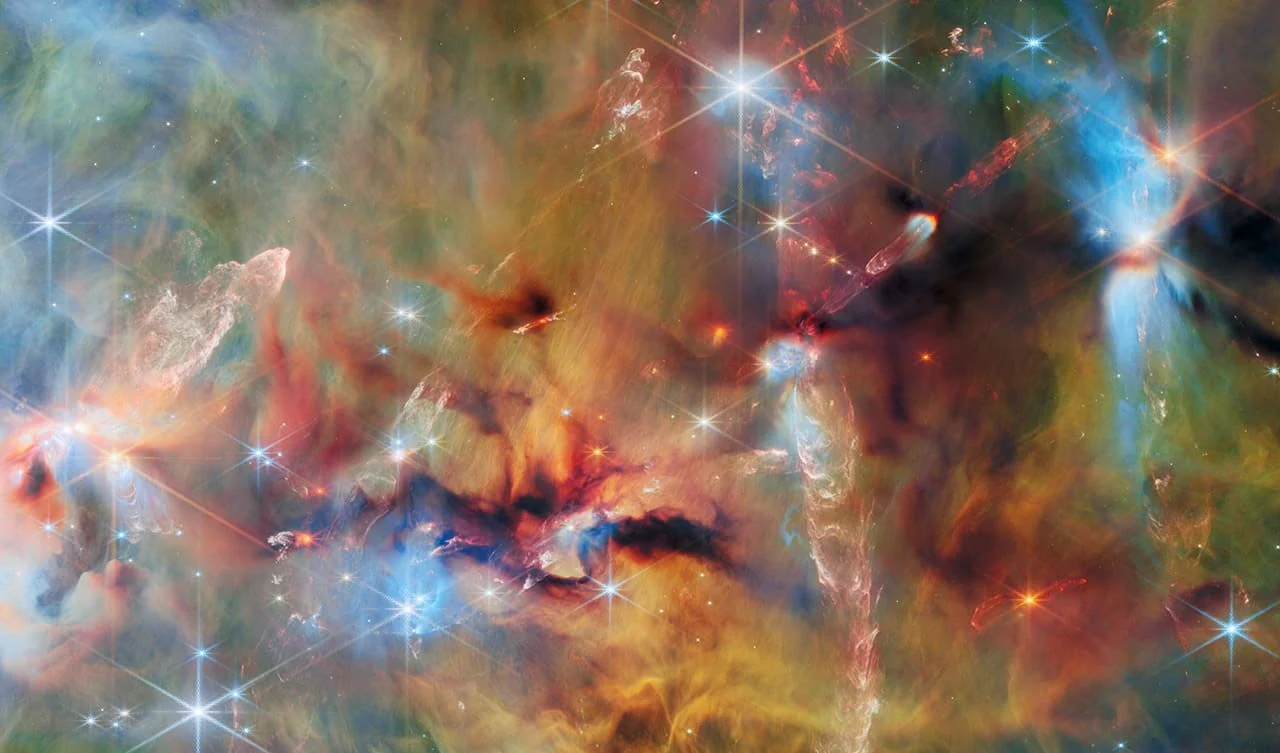
The James Webb Space Telescope, continuing its quest to uncover the secrets of the universe, has transmitted stunning images of the northern part of the Orion complex, located approximately one thousand two hundred eighty light-years from Earth. This was reported by Zamin.uz.
This region, known in the scientific world as a molecular cloud, allows for the study of the star formation process down to the smallest details. The newly acquired image covers a vast area spanning nearly one hundred fifty light-years, reflecting all stages of the development of celestial bodies.
The image shows everything from the initial clusters of gas and dust to young stars that have already formed and are emitting their own energy. This is considered a unique opportunity for astronomers to observe the processes of star birth in the universe.
At the center of the image are protostars accumulating matter, appearing alongside relatively mature objects that have dispersed the surrounding dense gas layers. The various colors in the image indicate differences in the temperature and composition of the gas and dust clouds.
Obtained using the James Webb telescope's near-infrared camera, this data revealed layers that ordinary optical devices cannot see. Infrared rays penetrate the dense dust curtain, clearly showing the processes hidden behind it.
Experts note that the blue and green hues in the image represent gas layers, while the reddish areas indicate powerful shock waves. Such high-resolution images are of great importance in understanding the evolution of the universe.
One of the most striking aspects of the image is the massive gas jets erupting from the poles of young stars. These jets collide with surrounding clouds at high speeds, creating shock waves that cause the matter to glow in red.
It is precisely these jets that help astronomers locate the youngest and most deeply hidden objects, as these objects cannot be seen by any other means.
According to scientists, this region serves as a unique laboratory for studying the impact of young stellar clusters on their surrounding environment. Through this data, researchers are analyzing how the chemical composition of planet-forming disks is created and how growing stars are nourished.
The relative proximity of the Orion Nebula provides a strong foundation for detailed research into processes obscured by dust in other parts of our galaxy.