



General Fusion tripled plasma temperature
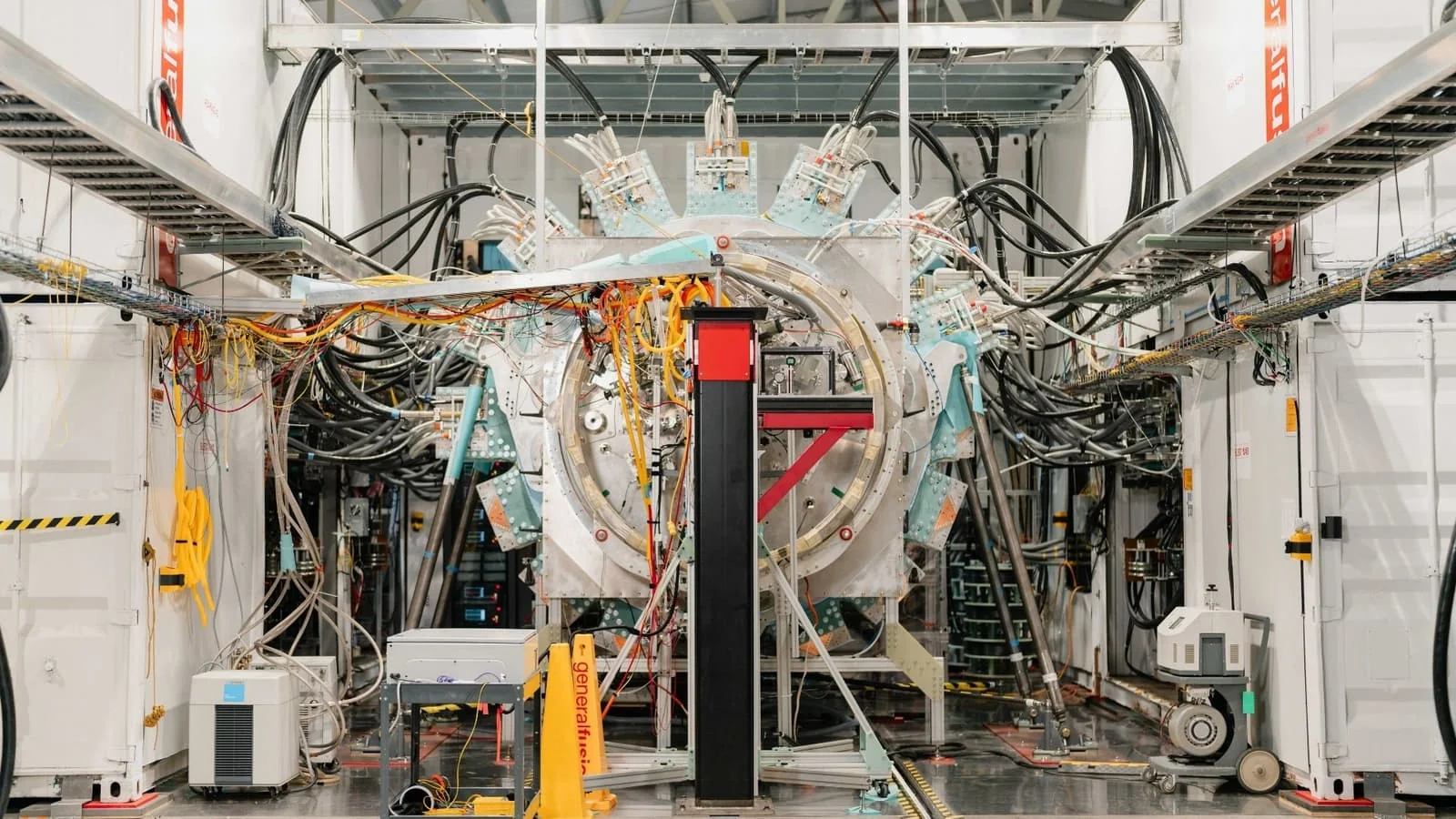
Canadian company General Fusion announced it has achieved a significant technological result during tests conducted on its Lawson Machine 26 device, as reported by Zamin.uz.
Researchers succeeded in increasing plasma temperature threefold using a mechanical compression method. This achievement brings humanity one step closer to the goal of obtaining unlimited and clean energy through controlled thermonuclear fusion.
According to the company, during the experiment, plasma temperature reached approximately 0.72 keV, which corresponds to about 8.4 million degrees Celsius. This result is considered a major milestone for the LM26 device.
The device was designed to demonstrate an approach known as Magnetized Target Fusion, which fundamentally differs from conventional thermonuclear schemes. Unlike traditional methods that rely on massive magnetic fields or powerful laser installations, General Fusion's technology uses a different approach.
The company's engineers compress plasma mechanically using a shell made of liquid lithium.
Although this method is technically complex, it is expected to enable the creation of simpler and more affordable reactors in the future. During the experiment, not only was the temperature increased, but the plasma density also rose tenfold.
Additionally, the strength of the internal magnetic field increased significantly. Researchers emphasized that the compression process proceeded stably, and contamination of the plasma by the lithium shell remained minimal.
This is a crucial indicator for such devices, as foreign substances can disrupt the reaction. Plasma temperature was measured at a given moment using several methods, including Thomson scattering and analysis of extreme ultraviolet radiation.
Furthermore, an increase in neutron flux was observed during compression, which may indicate that some thermonuclear reactions are occurring inside the device.
It should be noted that General Fusion has not yet achieved a positive energy balance.
In other words, the energy expended to conduct the experiment exceeds the energy obtained from it.
Moreover, these results have not yet undergone full independent scientific review and are currently at the stage of assessment.
The project team aims to increase plasma temperature to 1 keV in the next phase, and subsequently to 10 keV. In the long term, the company hopes to achieve stable and energetically beneficial fusion.
If this condition is met, thermonuclear fusion could cause a real revolution in the global energy market.