


Area 4478 on the Sun breaks 2024 records
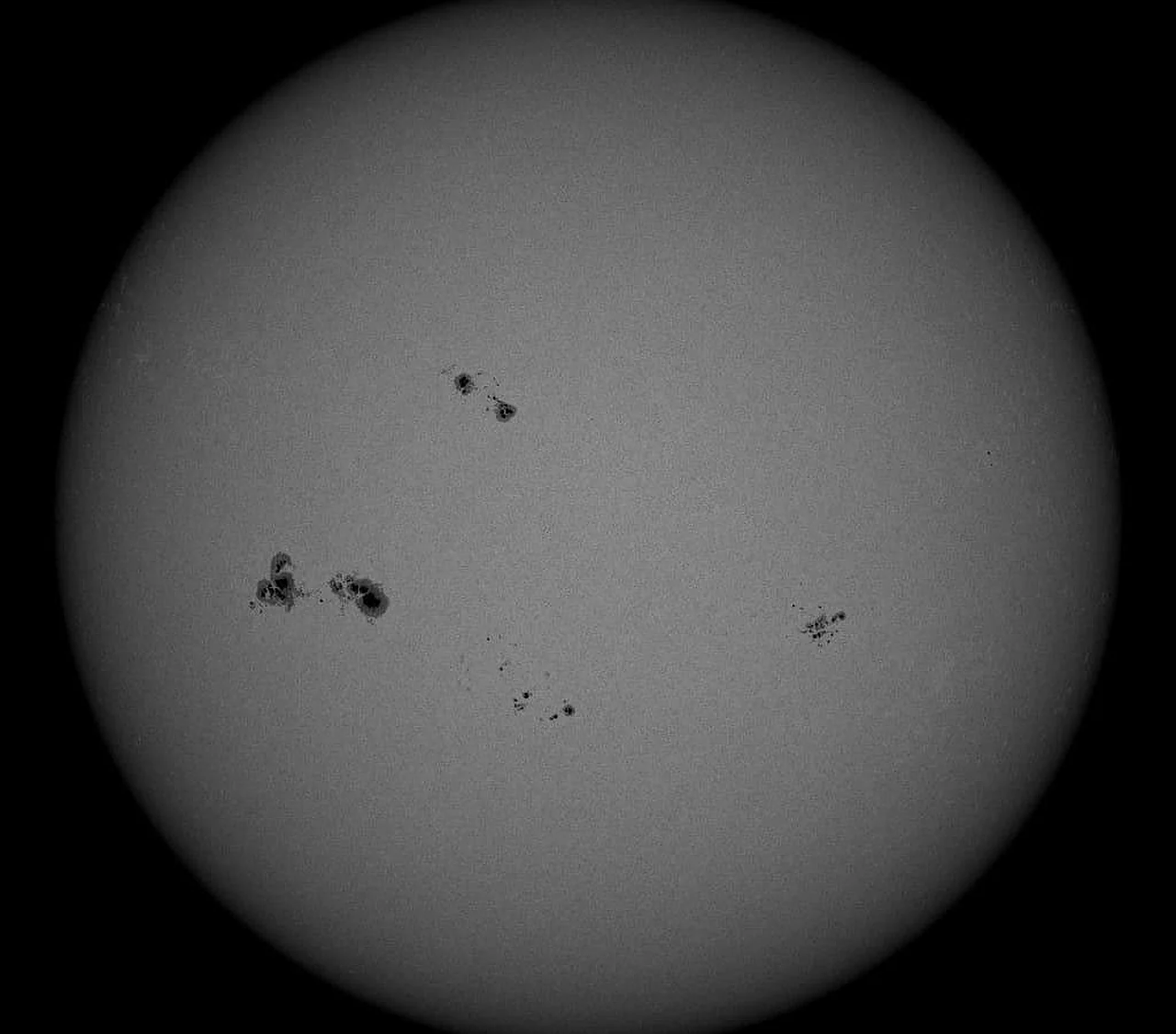
The largest active region observed on the Sun since the beginning of this year has formed. This was reported by Earth.uz.
According to specialists from the Solar Astronomy Laboratory of the Institute of Cosmic Research of the Russian Academy of Sciences, sunspot group No. 4478 has broken all records for 2024 in terms of its heliographic latitude. The area of this region reaches 1190 conditional units, significantly exceeding the previous record holder — group No. 4466 observed in February.
Recall that the February record-breaking region produced a powerful X8.1-class flare, which was among the most active solar events of the 21st century.
The newly identified region No. 4478, despite its enormous size, has so far not shown high-level flare activity. However, scientists warn that this calm may be temporary.
According to expert analysis, a large amount of energy is currently accumulating within this massive spot. Although there are no clear signs of strong flares in the near future, small-scale eruptions in solar plasma have already been recorded.
This indicates that dynamic processes are ongoing in the Sun’s inner layers. Preliminary calculations suggest that these small plasma flows could reach Earth’s magnetic field on June 30 and July 1.
This may lead to weak or moderate geomagnetic storms on our planet. Uzbek specialists also urge people sensitive to weather changes and those with chronic illnesses to exercise caution during such natural phenomena.
In the coming two days, this active region is expected to move almost directly onto the Sun–Earth line. In this position, any powerful flare or massive plasma eruption on the Sun would be directed straight toward Earth.
In such a scenario, the strength of geomagnetic storms and their impact on communication systems and power grids and communication systems may increase.
Currently, astronomical observatories and space monitoring systems worldwide are closely observing region No. 4478.
At a time when solar activity is approaching its peak, the emergence of such large sunspot groups is expected, but their unexpected consequences require constant vigilance. Scientists emphasize that the situation could change at any moment.