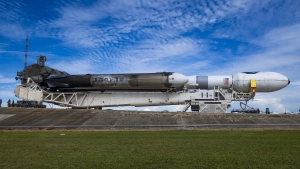
Rocket Lab company launched a Japanese artificial satellite into orbit

Rocket Lab, one of the leading players in the aerospace industry, has successfully completed its next launch, as reported by One.uz.
Launched from the spaceport in New Zealand, the Electron rocket successfully delivered Japan’s StriX-9 satellite into Earth orbit. The mission once again confirmed the reliability of the company’s technical capabilities and its growing competitiveness in the global space services market.
This flight marked the 54th mission of the Electron rocket in Rocket Lab’s history. During the flight, the modern spacecraft belonging to the Japanese company was deployed into a low Earth orbit at an altitude of approximately 575 kilometers.
The device is designed to significantly enhance the capabilities for monitoring Japan’s territory and the surrounding land surface. Using radar observation technology,
the StriX-9 satellite embodies synthetic aperture radar (SAR) technology.
The uniqueness of this system lies in its ability to obtain high-resolution images of the Earth’s surface regardless of weather conditions, cloud cover, or time of day — a significant advantage over optical satellites.
The acquired radar data is widely used in various fields, including urban planning, monitoring of large infrastructure facilities, and agriculture. Moreover, this technology plays a crucial role in rapidly assessing situations in areas affected by natural disasters and coordinating rescue operations.
Long-term strategic partnership This mission serves as a vivid example of the trusted cooperation between Rocket Lab and Japan. For the company, it is the 11th dedicated launch carried out for its Japanese partners.
It is worth noting that since 2020, Rocket Lab has been operating as the sole and exclusive launch provider for this project. The partnership between the parties is oriented toward long-term prospects.
According to the agreement, an additional 16 missions are planned through 2030 to fully deploy the orbital constellation. Such close cooperation will make a significant contribution to the development of the private space industry and the advancement of Earth remote sensing systems.