



Increased number of collisions in the sun and added probability of X class porting
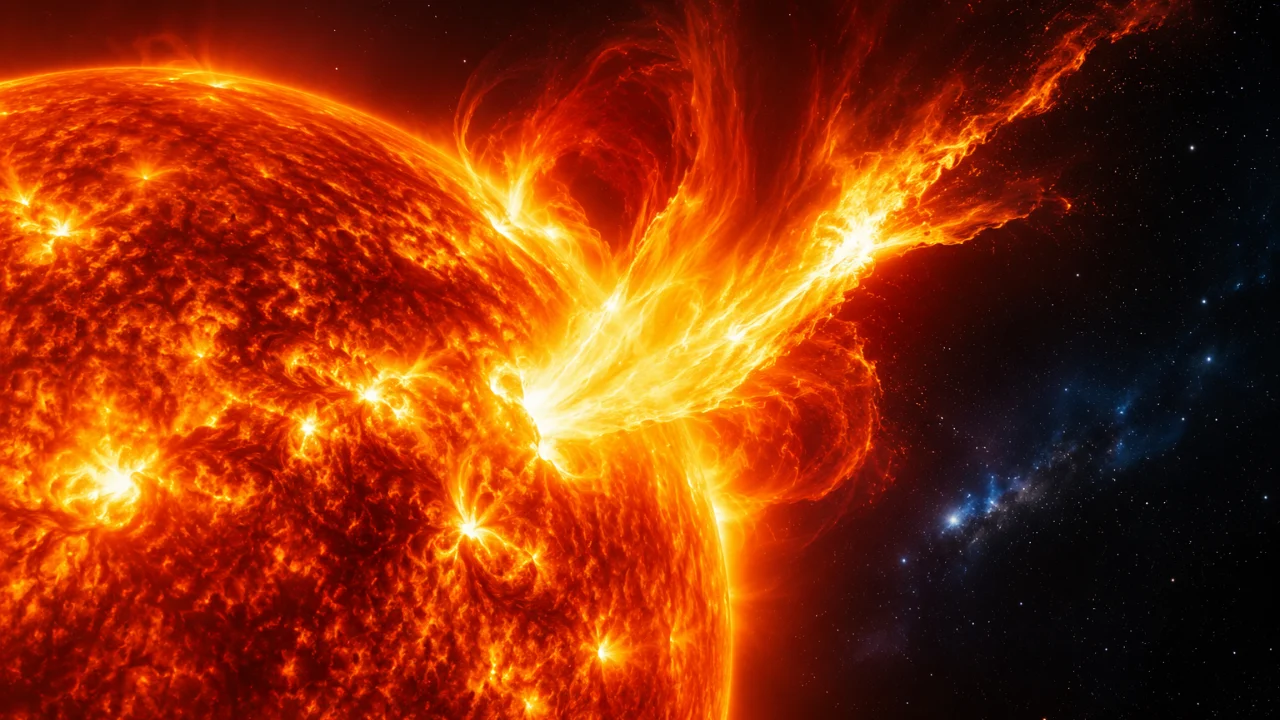
Astronomers have reported that solar activity has sharply intensified in recent days, according to Zamin.uz.
Experts warn that the current situation could become even more dangerous at any moment, with the possibility of the highest-level solar flares still remaining.
According to the Solar Astronomy Laboratory of the Institute of Cosmic Research at the Russian Academy of Sciences, a total of 17 flares were recorded on the Sun in the last 24 hours—a significantly higher rate compared to previous days.
Specialists note that just one day ago, there were 8 flares, and the day before that, only 5 were observed. This morning, two powerful flares belonging to the M class were recorded.
Scientists are not ruling out the possibility of an X-class flare—the highest category—occurring.
When compared to the active region observed in February, designated as sunspot group 4366, the current activity shows similarities.
At that time, several strong flares occurred, including the year’s largest X8.1-class flare in 2026. Astronomers describe this as a somewhat unusual situation.
This is because, although the largest active region of 2026 was facing Earth, no powerful X-class flares have occurred from it so far. However, experts emphasize that this calm may not last long.
They suggest that a powerful flare could begin at any moment. Why are scientists concerned?
It has been reported that this active region consists of two large sunspot groups connected by a single magnetic system, creating conditions for a significant energy release.
Astronomers stress that accurately predicting such complex magnetic systems is extremely difficult, as a large portion of the magnetic field lies beneath the Sun’s surface and cannot be fully observed.
As a result, the situation could evolve unexpectedly. How do solar flares pose a threat?
Solar flares are classified by intensity into A, B, C, M, and X classes, with X being the most powerful.
Such strong flares can affect Earth’s magnetic field, potentially triggering geomagnetic storms. These may cause disruptions in power grids, radio communications, and navigation systems, and in some cases, lead to issues with power supply at industrial facilities.
Furthermore, scientists highlight that geomagnetic storms may also influence the natural migration patterns of birds and animals.


![Fransiya Usmonova proposed removing [the name] from the sanctions list](/uploads/mini/web-300/04/e8d7de74763e0760c29bdbfd3d91b77a.webp)