Astronomers prove small changes in the cosmos can alter galaxy formation
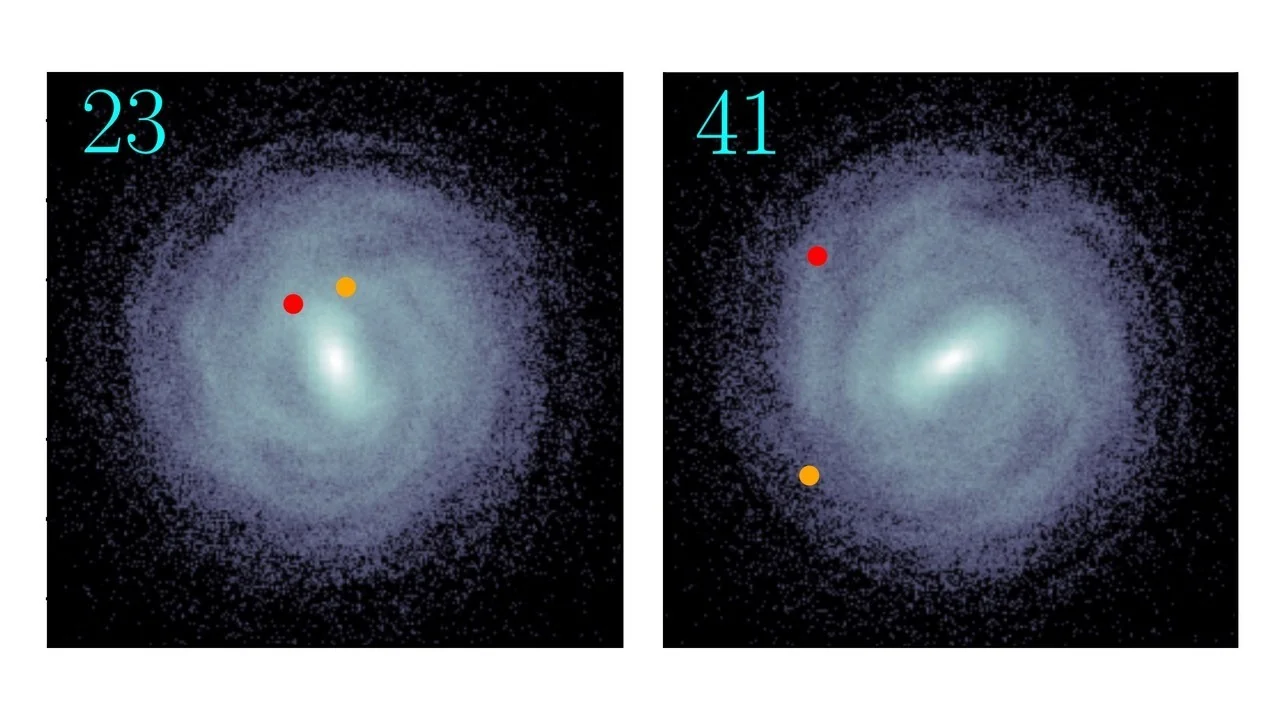
Astronomers from the Leiden Observatory in the Netherlands have developed models of dozens of stellar systems similar to our Milky Way galaxy, Earth.uz reports.
During the study, scientists created nearly identical conditions, changing only the position of a single star slightly in special computer experiments. The results showed that even the slightest change, over time, significantly affects the shape of the galaxy’s spiral arms and the rotation speed of its central region.
This situation resembles a phenomenon known in science as the butterfly effect. It has been proven that small fluctuations in a stellar system can, over time, completely alter the structure of an entire galaxy.
Previously, specialists believed that in vast systems consisting of billions of stars, such minor changes would naturally balance out and have no impact on the overall appearance. However, the new study has shown this assumption to be incorrect.
Researchers also succeeded in identifying why contradictions arose in earlier scientific studies. Often, to simplify complex calculations, stars were modeled not as individual bodies, but as diffuse clouds.
This approach artificially weakened gravitational interactions and smoothed out the true dynamics of chaotic motion within the galaxy. Nevertheless, the galaxy maintained its primary spiral shape.
According to the scientists’ conclusions, the ability to predict the exact structure of the Milky Way in advance will be lost entirely in about a million years. Compared to our galaxy’s ten-billion-year age, this is an extremely short period.
This discovery opens a new stage in understanding the evolution of complex systems in stellar environments.