


Japan Olympics Sets World Record for 6G Communications Technology
Researchers from Tokushima University, in collaboration with colleagues from the University of Tokyo and Gifu University, have achieved a significant technological breakthrough that brings the era of sixth-generation mobile communication networks closer. This was reported by Zamin.uz.
Experts in the field succeeded in transmitting data at a rate of 112 gigabits per second through a single channel in the ultra-high frequency range of 560 gigahertz. This achievement has been recorded as the first case in the history of world science where a speed exceeding 100 gigabits per second was achieved at frequencies above 420 gigahertz.
The reported innovation is expected to elevate the capabilities of wireless communication systems to an entirely new level in the future. The terahertz range is considered a fundamental foundation for sixth-generation networks of the future.
This is because this frequency range enables the creation of unique information highways with enormous bandwidth capacity. However, conventional silicon electronics encounters physical limitations at frequencies above 350 gigahertz.
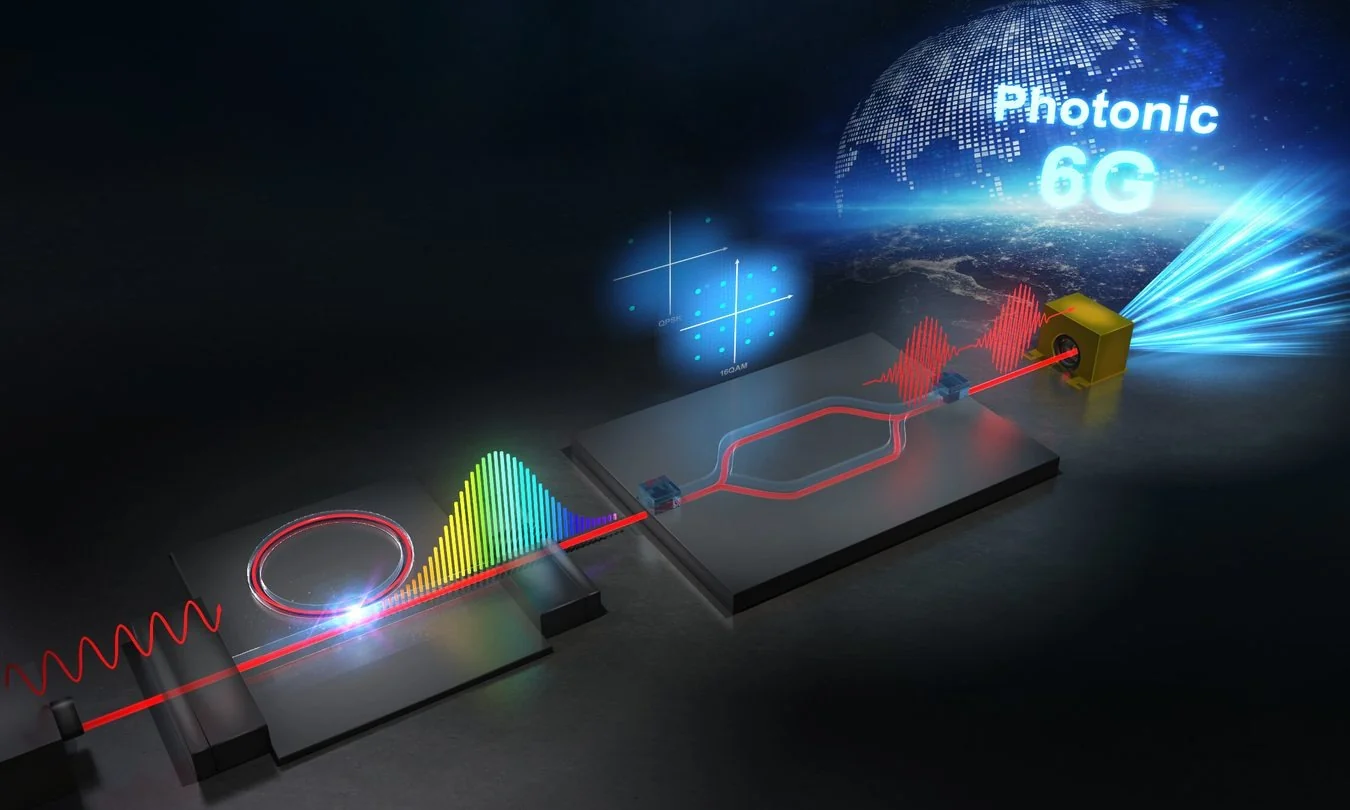
Under such conditions, transmitter power drops sharply, and noise levels increase significantly. A research group led by Takeshi Yasui decided to overcome this obstacle by abandoning conventional electronic generators and instead adopting the method of radio photonics.
The scientists used a soliton optical micro-comb device, smaller than a grain of human hair, fabricated on a special chip made of silicon nitride. This optical tool has the property of splitting a laser beam into multiple lines precisely tuned in frequency and phase.
By applying a special modulation technique, physicists succeeded in converting light into pure terahertz radio waves with unprecedented clarity, which ensured high accuracy and speed in data transmission.
In addition to achieving record-breaking speed, the authors also solved a complex problem related to the stable operation of the system. In previous laboratory tests, the schemes used were extremely sensitive to temperature changes and would cease functioning within a few minutes.
Engineers from Tokushima directly connected the optical fiber to the chip and installed an automatic temperature control system. As a result, the new device demonstrated the ability to operate continuously and reliably for more than 27 hours under laboratory conditions.
Although several more years will be needed before this technology appears in smartphones, physicists are currently working on increasing the signal transmission distance and further reducing noise.
The first practical application of this invention is expected to be in network infrastructure invisible to ordinary users—namely, the main communication channels connecting base stations. This will contribute to a fundamental improvement in mobile internet quality in the future.