


NASA's exoplanet discoveries have yielded two exoplanets with a fluffy cotton-candy-like density
Thanks to observations from NASA's TESS space telescope, two of the fluffiest known exoplanets have been identified, Earth.uz reports.
Named TOI-791 b and TOI-791 c, these objects are puzzling scientists with their enormous size and extraordinarily low density—so low, in fact, that it is comparable to that of cotton candy.
These rare worlds orbit TOI-791, a star similar to the Sun, located approximately 1,113 light-years from Earth.
Initial data were gathered using the transit method, which detects dips in starlight as a planet passes in front of its host star. Follow-up analyses revealed that the physical properties of these bodies challenge current assumptions about planetary composition.
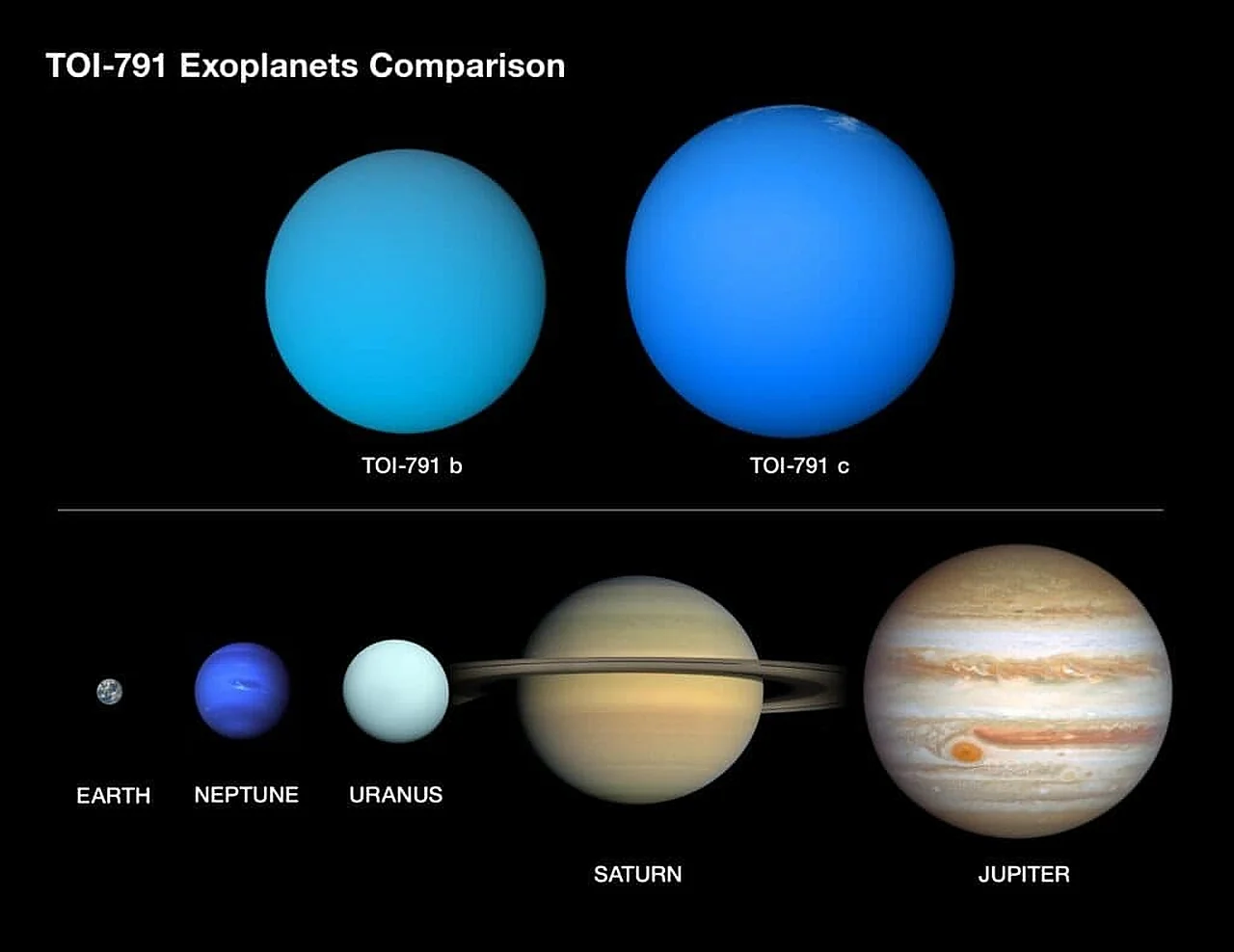
According to data from NASA's Ames Research Center, these Jupiter-sized gas giants are vast in volume but minimal in mass. TOI-791 b is roughly the same size as Jupiter, yet its mass amounts to only about 3% of the largest planet in our Solar System.
The second object, TOI-791 c, is even larger in diameter than Jupiter, but its mass is just 5.9% of Jupiter's. Such characteristics place these planets among the rarest objects in modern astronomy.
Their existence contradicts existing theoretical models of planet formation. Scientists are now working to understand how such low-mass gas giants can retain their expansive atmospheres.
This discovery demonstrates that gas giants in the universe may be far more diverse than previously thought. Their orbital behavior is also distinctive.
TOI-791 b completes one orbit around its star every 139 days, while TOI-791 c takes 232 days to do the same. Detecting such long-period orbits is a complex process requiring sustained observation over extended periods.
Another intriguing aspect of the system is that these two giants exert a strong gravitational influence on each other. As emphasized by Oxford researcher George Dransfield, finding two extremely low-density planets orbiting the same star is a rare event.
This system serves as a unique laboratory for studying planetary migration and evolution. In the future, scientists plan to analyze the chemical composition of the atmospheres of these planets to gain clearer insights into how they formed.
For now, researchers are using these unusual bodies in the TOI-791 system to reevaluate the stability limits of gas giants. This finding not only advances astronomy but also raises new questions about how the laws of physics manifest in extreme exoplanetary environments.