Artificial intelligence models are not logic, they are statistical manipulation
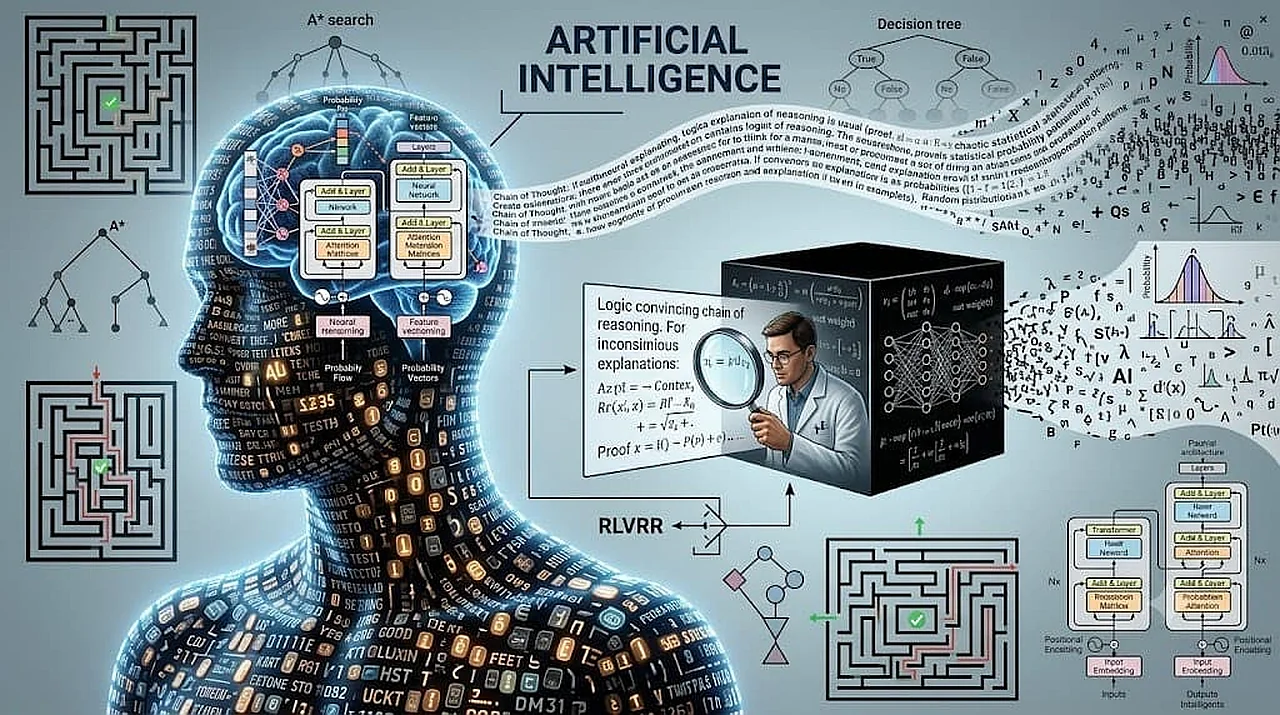
Large reasoning models such as OpenAI o1 and DeepSeek R1 are impressing the world with their seemingly human-like thinking abilities, Zamin.uz reports.
However, a new scientific study announced by researchers at the University of Arizona, led by Subbarao Kambhampati, challenges this perception of the researchers emphasize that long chains of thought are not actual, casts doubt on these assumptions. According to the scientists, the long chains of thought in neural networks are not actual cognitive processes but merely statistical manipulations.
According to the researchers, modern AI systems create logical sequences that generate a convincing illusion in users that an intellectual process is taking place. In reality, these models, based on the Transformer architecture, simply predict the next word statistically based on prior context—nothing more.
Equating this process with human logical reasoning is scientifically incorrect. Special attention was given to the "eureka moment"—the feeling of sudden insight when a tricky problem seems to be understood.
The scientists argue that this is not a change in the internal computation of the neural network, but merely a mimicry of human style found in the training data. Technically, these systems are optimized only for producing the final correct answer, and intermediate chains undergo no meaningful verification.
To test their hypothesis, the researchers used mathematical tasks such as escaping mazes and finding the shortest path. During the experiments, an unexpected result emerged.
The models continued to find correct answers even when their chains of logical reasoning were deliberately incorrect or garbled. This indicates that the system does not actually read its own reasoning steps but merely uses them as additional statistical patterns.
Another interesting case was observed in a simple maze task. Here, the AI was given a completely trivial, the simplest possible maze problem.
Despite this, the models generated multi-page chains of thought. This situation refutes the view that chain length reflects computational power or complexity.
Long texts are simply a statistical side effect arising because complex problems in the training data come with lengthy explanations. The scientists warn that the AI field risks falling into the theater of reasoning—a performative display rather than genuine understanding.
The plausible explanations presented by these systems can create a false sense of confidence in users. This is especially dangerous in fields like medicine, engineering, and law, where people might base critical decisions on multi-page texts generated by machines.
Therefore, deeply understanding the internal mechanisms of AI systems and objectively assessing their true capabilities is of critical importance.