


The Large Hadron Collider will be shut down for four years
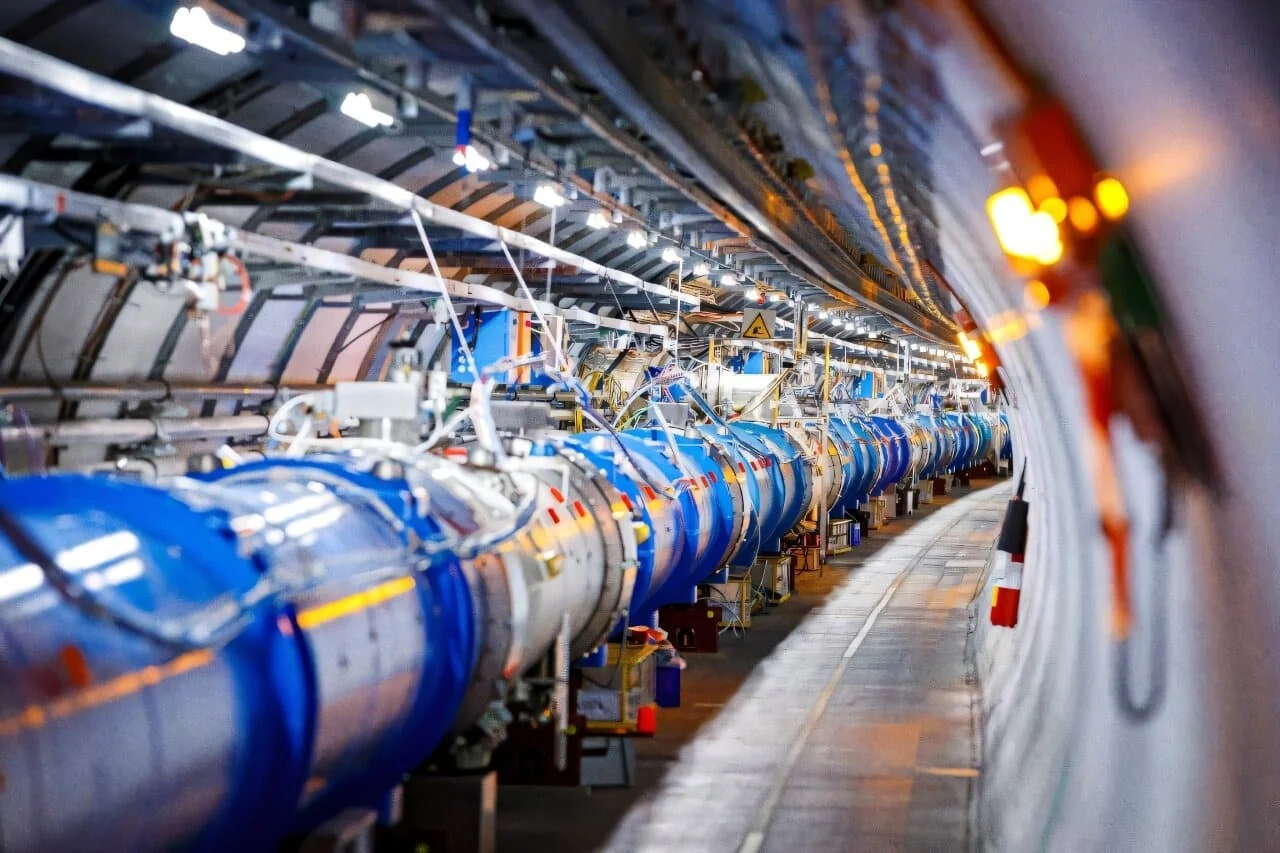
The world's largest and most powerful particle accelerator — the Large Hadron Collider (LHC) — has temporarily halted operations for a four-year major upgrade, according to Zamin.uz.
This project, carried out by the European Organization for Nuclear Research (CERN), aims to open a new chapter in studying the universe's deepest mysteries, including dark matter and dark energy. Located in a 27-kilometer underground ring straddling the border between Switzerland and France, at a depth of 100 meters, the LHC made history in 2012 with the discovery of the Higgs boson.
Now, specialists plan to upgrade the facility to a significantly higher performance level. After modernization, the collider will be renamed the High-Luminosity Large Hadron Collider (HL-LHC), with its upgraded version expected to go online in June 2030.
According to project leader Markus Tserlauf, this phase is decisive for the success of the entire program. The main goal of the modernization is to sharply increase the number of particle collisions — in other words, to boost the luminosity.
According to the plan, luminosity will increase tenfold compared to current levels, enabling scientists to collect up to 100 times more data than today. To achieve this, approximately 1.2 kilometers of the accelerator ring will be completely replaced.
New superconducting magnets will be installed, allowing for much more precise focusing of particle beams. As a result, the number of collisions per interaction will rise from the current 60 to as many as 200.
This will provide physicists with an unprecedented volume of data. Such a massive increase in data flow presents new technological challenges for engineers.
It is impossible to record every single one of the billions of events occurring each second. Therefore, CERN specialists plan to use artificial intelligence systems to identify and extract the most significant and promising collisions in real time.
Artificial intelligence will not replace physicists but will act as a filter: AI systems will detect rare events that could signal new physics and isolate them for further analysis.
This will help scientists study dark matter and dark energy — which together make up 95% of the universe but remain largely unknown to us. The implementation of the HL-LHC project is important not only for theoretical physics but also for the advancement of high technologies.
For young Uzbek scientists and researchers, experience at CERN has always been a center of interest. This step toward answering fundamental questions about the origin of the universe and the structure of matter is expected to profoundly reshape humanity's understanding of the laws of nature.