


The summary of the water plumes on Jupiter’s moon Europa turned out to be wrong
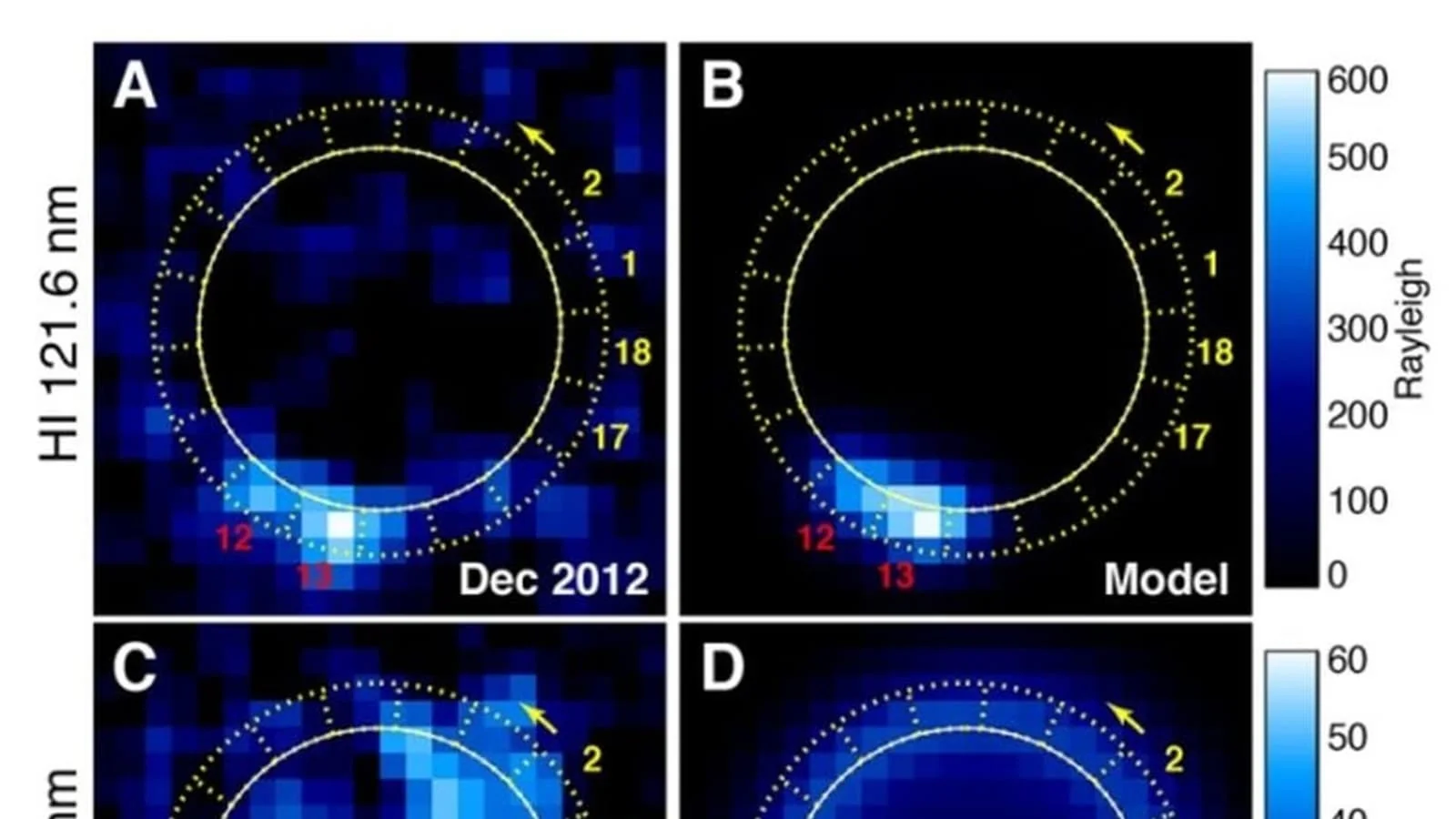
A study published in 2014 in the prestigious journal Science had raised great hopes for the study of frozen moons in the Solar System. This was reported by Zamin.uz.
At that time, based on data from the Hubble Space Telescope, scientists announced that water vapor was being ejected to a height of 200 kilometers from beneath the ice shell of Jupiter's moon, Europa. However, recent scientific research indicates that these conclusions were incorrect and that the sensational discovery at the time was actually the result of a technical error.
A new article published in the journal Astronomy and Astrophysics notes that this debunking effort was led by Lorenz Roth, a doctor at the Royal Institute of Technology in Sweden and the author of the 2014 article. His team meticulously re-analyzed all the data collected by the Hubble telescope over fourteen years.
The results showed that the phenomenon previously perceived as giant geysers occurred as a result of incorrect linking of coordinates in the telescope's sensor. According to the researchers, shifting the position of the moon's disk in the image by just one or two pixels completely changed the spectral analysis.
When correct calculations were performed, it became clear that the giant 200-kilometer plumes thought to be ejected into space were actually a simple statistical error. This news was an unexpected blow to the Europa Clipper probe recently launched by NASA.
This spacecraft, which will reach the Jupiter system in 2031, had planned to study the composition of the ocean through those very geysers without the need for drilling. Now, serious changes may be made to the scientific program of the space mission, as it has become known that ocean samples are not being ejected into open space.
Despite this, scientists are not completely denying the existence of a subsurface ocean on Europa. Geological evidence still indicates the presence of liquid water beneath the ice layers, but it has become clear that the process of studying it will be much more complex than previously assumed.
The Europa Clipper spacecraft, which will reach its destination in five years, will put a final point to this controversial issue.