


Canada Olympics created technology to print wind turbine blades
The Concordia University in Canada has demonstrated a technology that could spark a revolution in the renewable energy sector, according to Zamin.uz.
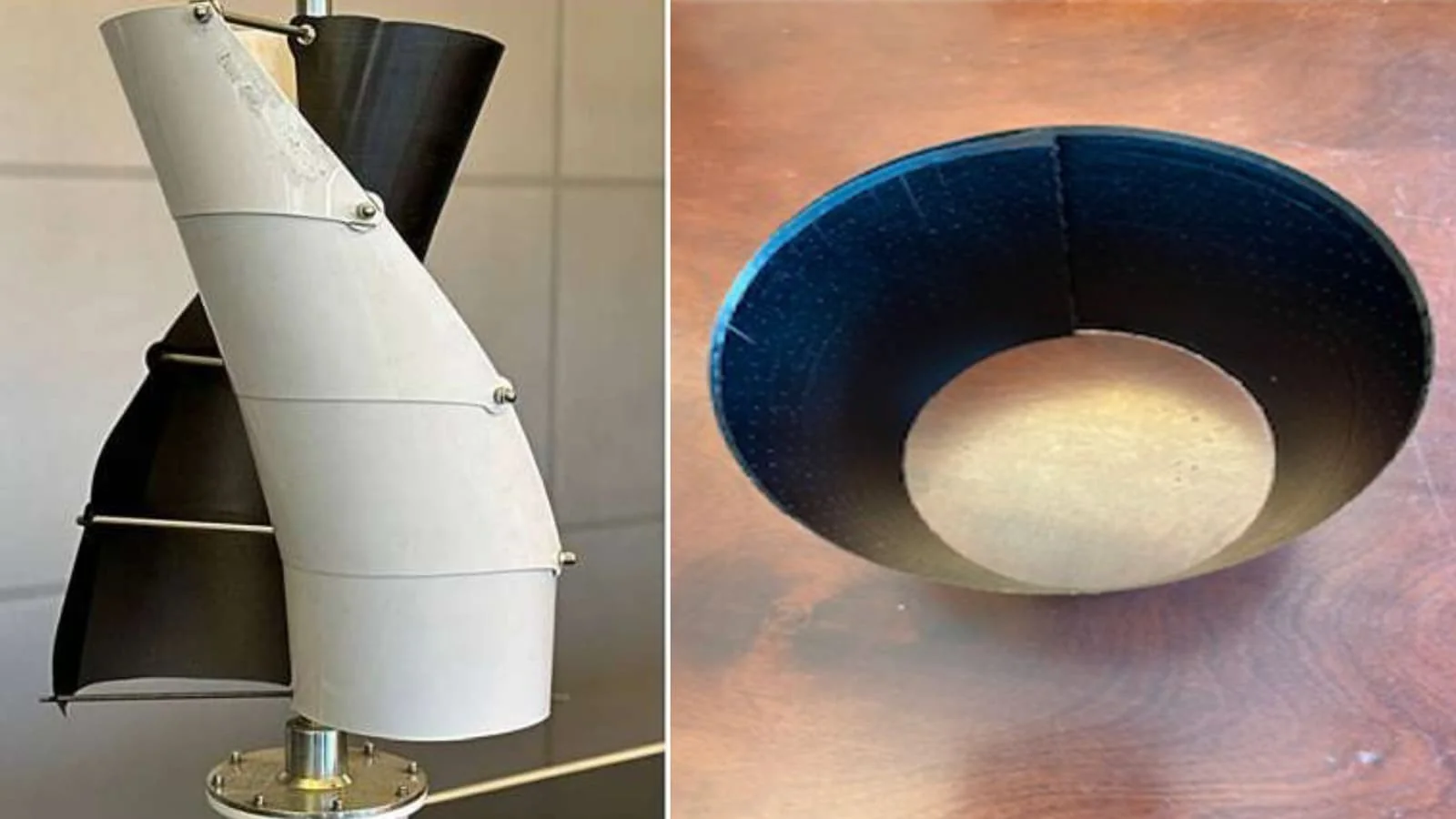
Researchers have found a way to produce blades for wind turbines, casting or molding, but by using four-dimensional printing technology.
This new approach not only manufacturing but also simplifies the entire process.
The key feature of four-dimensional printing that the device blades are not produced in their final shape, but are printed as a completely flat composite sheet.
After manufacturing process is complete, these flat details automatically take on the required aerodynamic shape without without any external mechanical influence.
This eliminates the need for complex molds and expensive processing equipment, while increasing production efficiency.
According to the project authors, the process is based on reverse engineering design principles.
Engineers first calculate the exact final shape of the blade, then determine how to lay layers of carbon fiber and special resin to achieve it.
As the composite material cools and solidifies, internal stresses develop within it, forcing the detail to bend into the pre-programmed shape and achieve the desired result.
Laboratory tests showed results that exceeded expectations.
Blades made using the new method turned out to be nearly 60 percent lighter than their traditional aluminum counterparts, while fully retaining their aerodynamic properties.
This is a key factor in increasing the efficiency of wind energy installations.
The low weight allows the blades to start rotating even at low wind speeds.
During testing, turbines equipped with the new blades were observed to spin faster than those with metal blades, directly increasing energy output.
The developers emphasize that this technology is especially promising for small-volume vertical wind turbines installed on building rooftops in cities, where compactness and efficiency are crucial.
In countries like Uzbekistan, where attention to renewable energy sources is growing, the widespread adoption of such affordable and efficient technologies could be of great importance.
In the future, this approach could be applied not only in energy, but also in other industries requiring complex, lightweight parts—such as aviation and automotive manufacturing.
This could mark the beginning of a new era in industry.