Olympians estimated that the Earth would survive the Sun's final stage
The Institute of Astronomy at the University of Leuven in Belgium has presented new scientific findings regarding the future of our planet, as reported by Zamin.uz.
According to the study, Earth may survive the final stages of the Sun's life, a possibility specialists note is significantly higher than previously estimated in scientific assessments.
The results of this research were published in the influential journal Astronomy and Astrophysics. By observing stars similar to the Sun but at a more advanced stage of evolution, scientists were able to reassess Earth's fate.
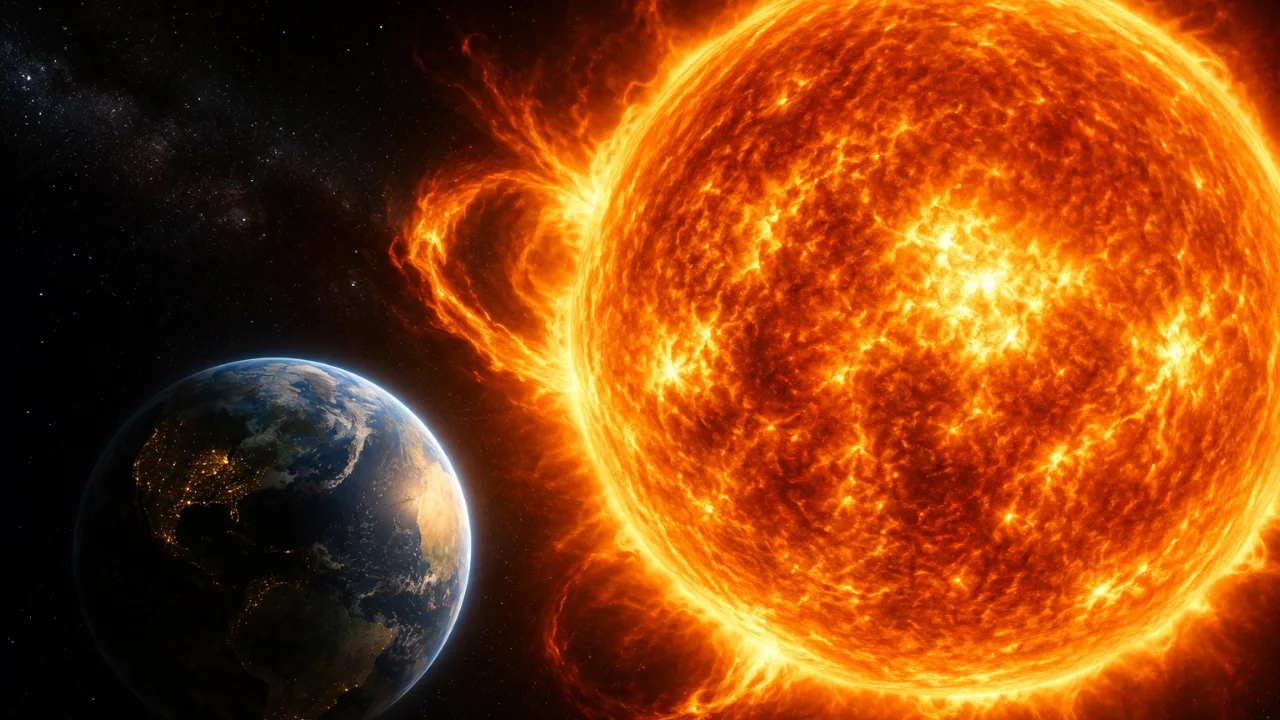
Experts explain that in approximately five billion years, the Sun will exhaust the hydrogen reserves in its core. After that, it will enter the red giant phase, expanding to nearly a hundred times its current size.
During this massive transformation, Earth will experience two opposing forces. On one hand, the Sun's rapid expansion could engulf and destroy the planet.
On the other hand, as the star sheds its outer layers into space, its overall mass will decrease. This reduction weakens the Sun's gravitational pull, potentially allowing Earth to drift into a more distant orbit.
According to the study's lead author, Mats Esselders, Earth's future depends precisely on the balance between these two processes. If the orbital expansion due to mass loss occurs faster than the Sun's expansion, the planet may escape the danger zone.
To reach this conclusion, scientists also examined a distant star located about two hundred light-years from Earth. This star once had characteristics similar to the Sun but is now undergoing the final phase of its life cycle.
Based on modern gravitational models, calculations suggest Earth may have a chance to survive. However, researchers emphasize that additional observations and more precise data are still needed to fully confirm this outcome.
At the same time, the study indicates that the situation for Mercury and Venus is much more dire—these planets are highly likely to be engulfed by the Sun's expanding outer layers.