


NASA selects volunteers for Mars missions
The National Aeronautics and Space Administration (NASA) of the United States has announced a new scientific project aimed at preparing for future missions to the Moon and Mars. This was reported by Zamin.uz.
As part of this unique program, four volunteers will be selected to live for one year in a specially designed environment that simulates the conditions of space life. The program will allow participants to directly experience the challenges they may face during long-duration spaceflights in the future.
According to official information from the agency, the scientific experiment will begin in August 2027 at the Johnson Space Center in Houston, Texas. The main goal of the project is not to simulate an actual spaceflight, but to fully recreate the living conditions of other planets on Earth.
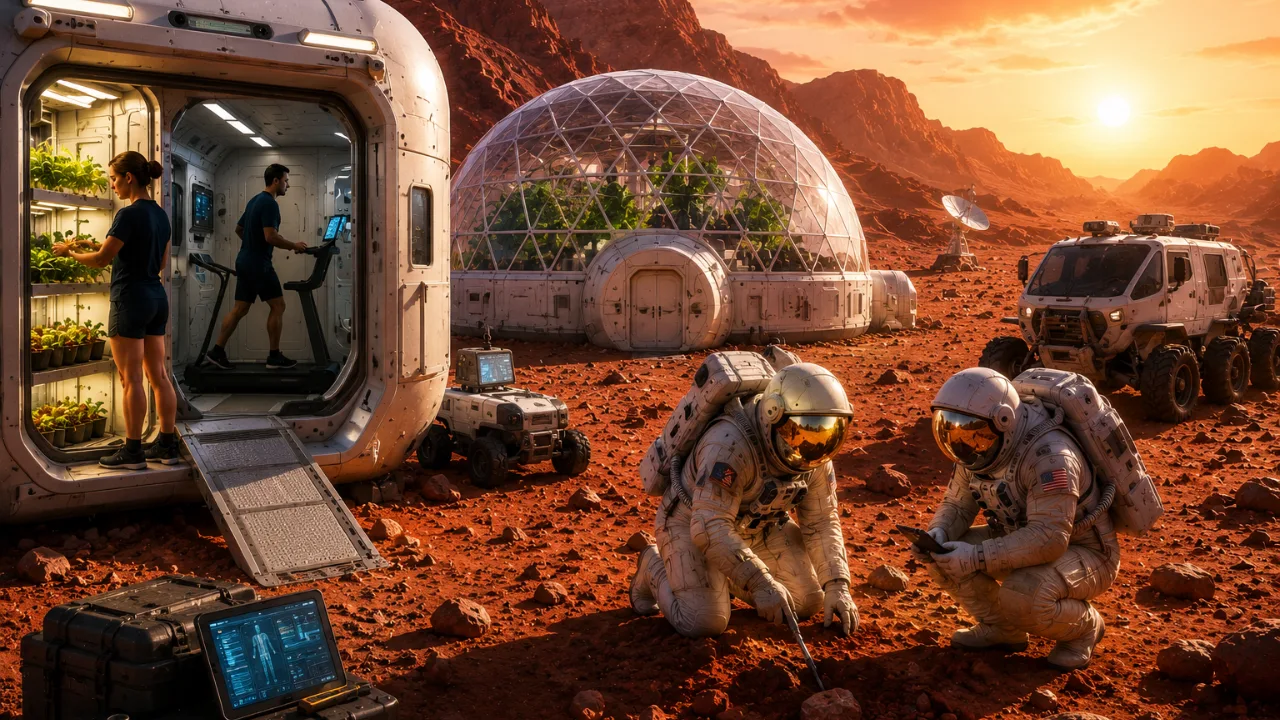
The selected volunteers will spend twelve months isolated from the outside world, performing daily tasks that astronauts are required to carry out in a confined habitat. They will undergo complex trials such as growing their own food, continuously monitoring their health, and conducting simulated spacewalks outside the habitat.
Experts aim to use this study to determine how the human body and mind adapt to long-term isolation and the extent to which they can withstand space-like conditions. Additionally, the fact that a day on Mars is approximately forty minutes longer than on Earth will be closely studied to understand its impact on human biological clocks.
Such data will play a crucial role in ensuring the safety of future crewed missions to Mars. The requirements for participants in the project are also strictly defined.
Only citizens of the United States or individuals holding documents granting permanent residency in the country are eligible to apply. Applicants must be between the ages of 30 and 55, and their height must not exceed 188 centimeters.
Proficiency in English is also considered a key requirement. Applications from candidates with higher education in engineering, biology, physics, or mathematics, those engaged in scientific activities, or those with military service experience will be given priority.
The experiment will consist of three main stages. In the initial phase, volunteers will reside in a module simulating the interior of a spacecraft.
They will then be transferred to a specially designated area simulating the Martian surface, where they will develop skills in agriculture and working in an external environment. In the final stage, participants will return to the spacecraft habitat environment to simulate the process of returning to Earth.
NASA leadership expresses confidence that this project will represent the next major step in humanity’s journey toward mastering space.