Artificial lighting solved the problem of studying the colony at night
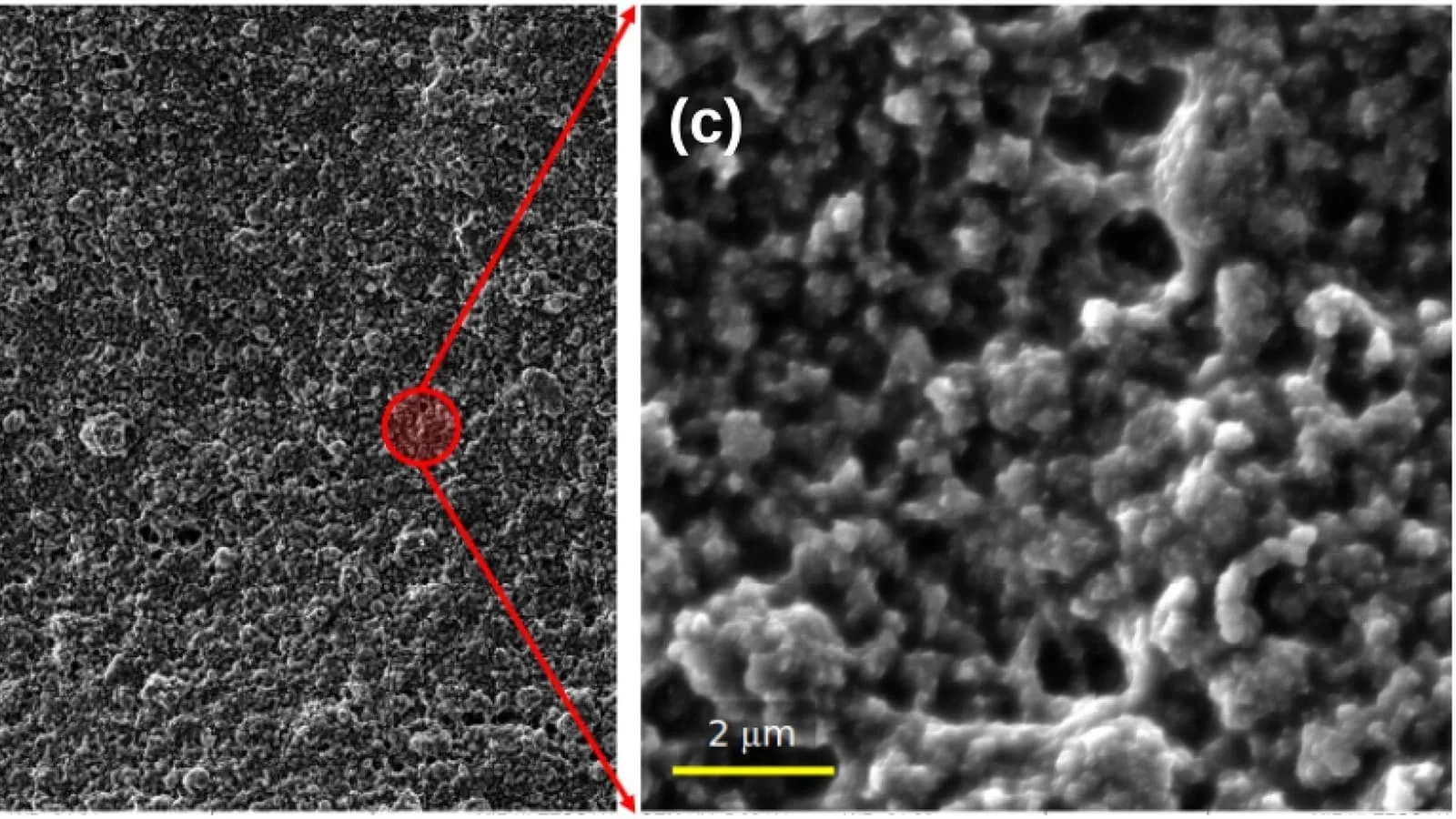
The University of Surrey in the UK has found an effective way to address the growing problem of artificial satellite brightness interfering with astronomical observations. This was reported by Zamin.uz.
Researchers tested a super-black coating called Vantablack 310 and demonstrated that it can make orbiting devices nearly invisible to ground-based telescopes. This discovery is expected to significantly reduce the negative impact of millions of new satellites planned for launch in the coming years on astronomical observations.
The rapid increase in the number of artificial satellites in Earth's orbit has become one of the biggest threats to modern astronomy. According to existing projects, over a million seven hundred thousand satellites could be launched into orbit in the near future.
Sunlight reflected from the metallic surfaces of artificial satellites creates bright lines and flares in images taken by telescopes, making it difficult to detect faint celestial objects such as distant galaxies, asteroids, and very dim stars.
According to a study published in the Journal of the Royal Astronomical Society, this special material developed by Surrey NanoSystems returns only about two percent of the light that falls on it. Scientists analyzed how a satellite coated with this material would appear from Earth using laboratory experiments and computer modeling.
The results showed that the brightness of the device could be reduced to the lowest level recommended by the International Astronomical Union. Another important advantage of this technology is that it scatters reflected light uniformly in all directions.
This prevents the sharp and bright flares typically observed on metallic surfaces. As study leader Astha Chaturvedi emphasized, the night sky remains one of the most important tools for studying the cosmos, but observing it is becoming increasingly difficult.
The new engineering solution offers a way to solve the problem without fundamentally altering the structure of artificial satellites. According to astrophysicist Noelia Noel, this issue should concern not only professional astronomers but everyone who wishes to preserve the natural appearance of the night sky.
The study marks an important step from merely identifying the problem to developing practical solutions. Researchers now plan to test the coating under real space conditions.
The next phase of the project involves applying the new coating to a dedicated artificial satellite and launching it into orbit. Conducted in collaboration with the Universities of Portsmouth and Southampton, this scientific mission will help determine how well the material retains its properties in the harsh environment of space.
If the tests are successful, in the future all artificial satellites could be protected using this methodically protected in this way.